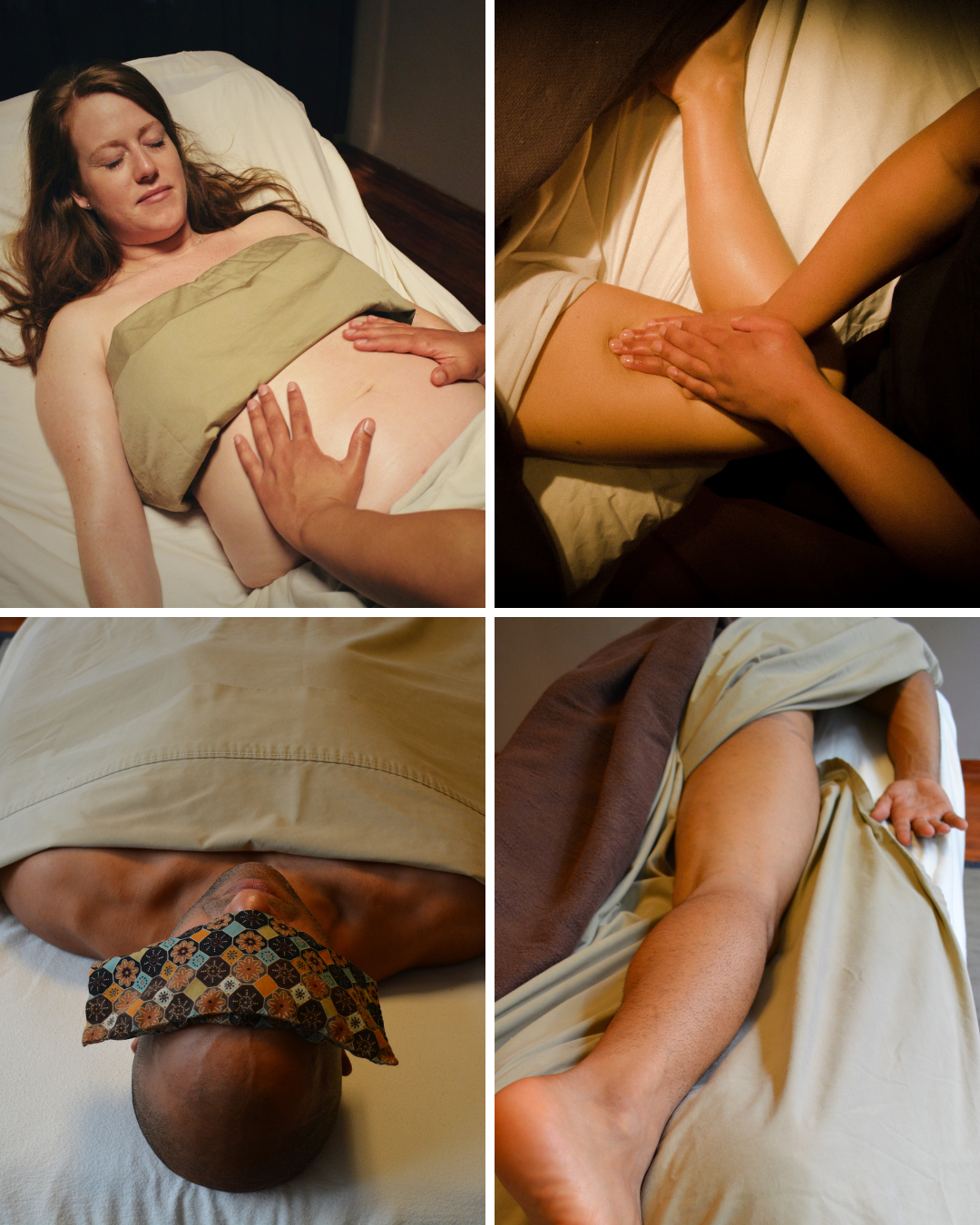
You're Covered: Draping as a Standard of Care in Bodywork

Clean, well-executed draping is both a professional standard and part of the overall experience of care.

What is draping?

Draping is the method of using sheets or coverings to keep the body appropriately covered during a session while exposing only the area being worked.

Draping Matters More Than You Realize

Clean, well-executed draping is both a professional standard and part of the overall experience of care—it shapes how comfortable a client feels and how seamlessly the session can unfold.

In practice, draping is one of the most defining elements of a session. Aside from keeping the body warm, the sheets foster a sense of comfort and trust. Draping is non-verbal communication between client and practitioner that says: this is the area being addressed, and you will not be exposed unnecessarily.

A Foundation of Safety and Trust

Clean, tight draping supports trust in a very tangible way. Sheets that are secure and well-placed remove uncertainty. There’s no second-guessing what might be exposed, no need to hold tension in anticipation. The body can settle.

Loose or careless draping does the opposite. Even if nothing inappropriate happens, the possibility of exposure can keep the nervous system slightly activated. Subtly, but enough to limit how deeply the client can relax.

I talk about nervous system care. Draping is part of that. Each adjustment of the sheet is a moment of contact. It can feel abrupt or it can feel considered. It can feel like something being done to you, or something that’s part of a coherent, respectful process.

Predictability matters. When transitions are smooth, when the sheet moves in a way that feels contained and intentional, the body stays regulated. There’s no abrupt exposure, no fumbling or hesitation. Draping done well communicates safety. The client doesn’t have to think, monitor, or brace.

Precision Creates Possibility

Secure, intentional draping also determines how effectively I can move work. It’s not just about coverage. It’s about clarity, precision, and care.

When the sheet is anchored properly, I can work unencumbered. No adjusting and fumbling with a loose sheet; I can move limbs into stretches and different positions without worry of accidental exposure. I can expose exactly what I need, when I need it, without disrupting the rest of the body. Transitions become fluid. The session maintains continuity.

Clean draping allows for:

  • Clear access to specific areas without overexposure

  • Smooth transitions between regions of the body

  • A grounded, uninterrupted flow to the session

The Detail That Changes Everything

Clients aren’t always aware of the importance of draping, but when it’s done well they feel the difference immediately. Tight, intentional draping honours the body as a whole, even when only one area is being worked. Nothing is incidental. Nothing is left to chance.

For me, draping is as important as any other aspect of the session. Everything is intentional and has the nervous system top of mind. Not as an afterthought—but as part of the work itself.

Secure draping helps you relax, breathe, and let go.

What is Buccal Therapy? Intraoral work for TMJD and Facial Conturing

Why work inside the mouth?

For many people, this is where long-standing tension is held. Most approaches to jaw tension focus on external muscles—the jawline, temples, and neck. While that work is important, it doesn’t always reach the deeper structures involved in clenching, grinding, and TMJ discomfort. Working from the inside creates a more complete picture of what is happening in the jaw.

Buccal therapy allows direct access to muscles that:

  • are responsible for closing and stabilizing the jaw

  • contribute to clenching and grinding patterns

  • can remain tight even when external work has been done

What muscles are being addressed?

Buccal therapy primarily works with:

  • Masseter – one of the main chewing muscles, often thickened and overactive in people who clench or grind

  • Medial pterygoid – located inside the jaw, working with the masseter to close the mouth

  • Buccinator – the muscle of the cheek, which can hold tension and affect how the jaw and face move

  • Surrounding connective tissue and fascial layers within the cheeks

These muscles are difficult to access externally with the same level of specificity.

How it works

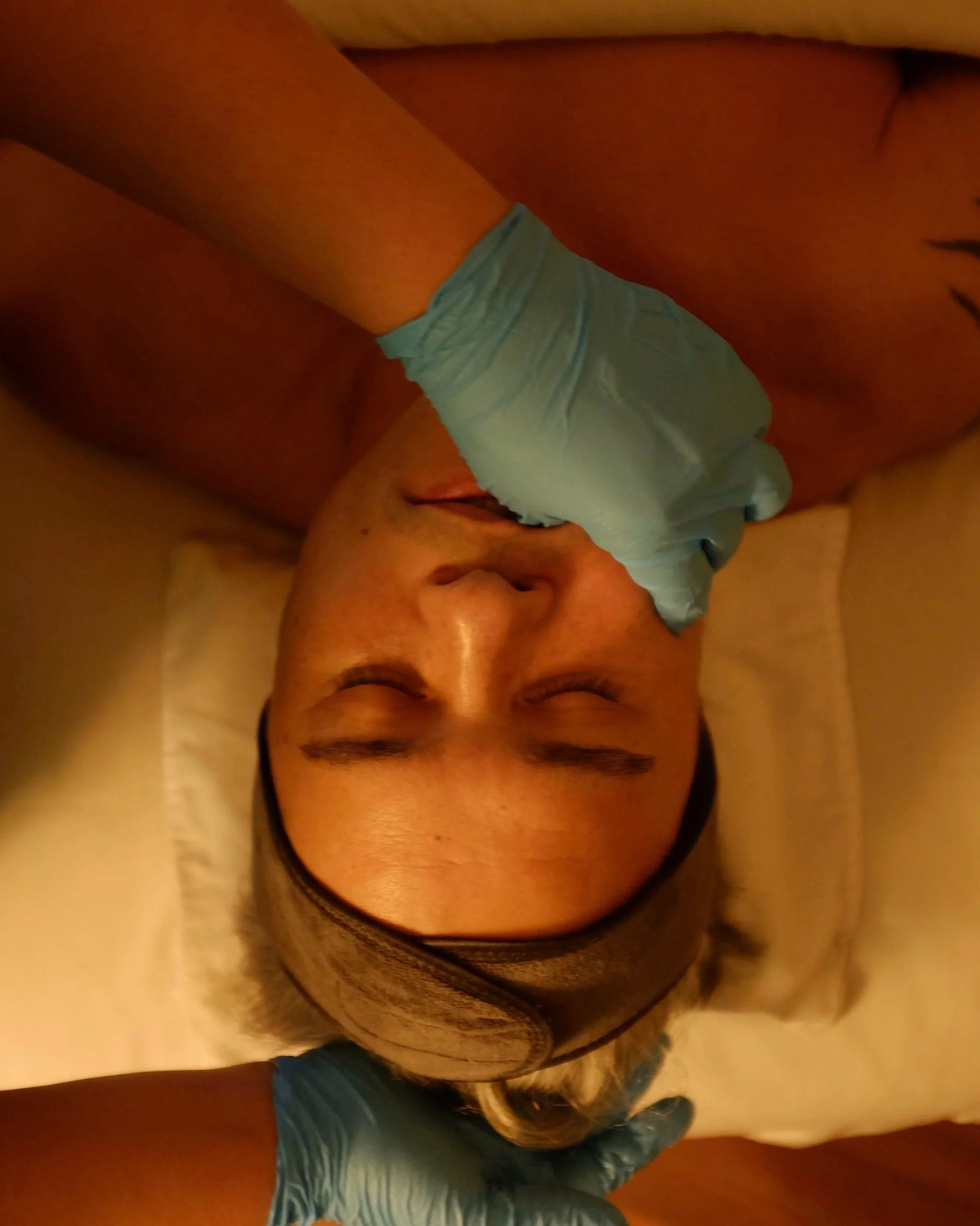
One hand is placed inside the mouth (with gloves), while the other supports externally. This allows me to feel the tissue from both sides and work with precision.

Pressure is controlled and responsive. The goal is not to push through tension, but to meet it and allow it to change.

Sessions are always guided by feedback and pacing. You are not expected to tolerate discomfort or “push through” the experience.

What it helps with

Buccal therapy can be particularly effective for:

  • jaw tension and chronic clenching

  • TMJ discomfort (clicking, restriction, uneven movement)

  • teeth grinding (bruxism)

  • headaches related to jaw and temple tension

  • facial tightness or fatigue

  • neck tension connected to jaw holding patterns

Because the jaw is part of a larger system, this work is often combined with treatment for the neck, shoulders, and scalp.

What it feels like

For many people, this is a new experience.

It can feel intense at times, but it should not feel overwhelming. The work is specific, supported, and paced in a way that allows the body to respond.

Often, there is a noticeable shift:

  • the jaw feels lighter

  • the face softens

  • the range of motion improves

  • the nervous system settles

In some cases, there may also be an emotional response. This is not something that is created by the work, but something that can surface when long-held tension begins to change.

Is it necessary?

Not always.

Buccal therapy is one approach within a broader treatment. For some people, external work is enough. For others, especially with chronic jaw tension or TMJ patterns, intraoral work can make a significant difference.

It is always optional.

A more complete approach

Buccal therapy is most effective when it is part of a full-body approach.

Jaw tension is rarely isolated. It is connected to the neck, shoulders, breathing patterns, and overall nervous system state.

By addressing the system as a whole, the results tend to last longer and feel more integrated.

If you’re dealing with jaw tension or TMJD

There are ways to work with these patterns that go beyond surface-level relief.

Buccal therapy offers a direct and effective way to access deeper layers of tension and support meaningful change.

Aesthetic benefits

While buccal therapy is rooted in working with tension and function, there are visible changes that often come with it.

The face reflects what is happening underneath. When muscles are overactive, holding, or restricted, it can show up as heaviness, puffiness, or loss of definition.

By working directly with the deeper structures of the cheeks and jaw, buccal therapy can support:

  • a more lifted, defined appearance (often described as a natural facelift)

  • reduced puffiness through improved lymphatic drainage

  • softening of nasolabial folds

  • more contour through the cheekbones and jawline

  • improved symmetry in how the face sits at rest

These changes are not forced or superficial.

They are a result of releasing tension, improving circulation, and allowing the structure of the face to reorganize.

The aesthetic shift is often noticeable, but it reflects something deeper—less holding, more ease, and better movement through the tissues.

GLOW is a 60-minute facial-focused bodywork session available at Breathing Space Bodywork. It includes intraoral (buccal) therapy, along with gua sha and facial cupping.

A targeted TMJ add-on (RELEASE) is also available with a 60-minute or 90-minute bodywork session.

Book online: https://breathingspacebodywork.as.me/glow

When the Body Feels Safe Enough to Let Go

Yesterday, I received bodywork from a colleague of mine. As soon as her hands made contact, everything shifted. I felt it immediately—a sense of being cared for, of being met, of being heard.

She approached me with confidence and kindness. Her hands were attentive and specific. She immediately sensed where my body was holding and went there with clarity. Not forcefully, but with a kind of quiet precision that let me know she “had me” then, I started to cry.

Not because something was wrong, but because something was right.

In that moment, I realized, this is what people feel when they are on my table… safe and cared for!

(It so rare for me to feel completely safe in the hands of another practitioner. And that is a topic for another blog post)

Safety is felt, not forced.

Safety is not something we think our way into. It is something we feel. It shows up in the way someone makes contact, in the pacing of their touch, and in their ability to stay present without trying to change what is happening. When that kind of care is present, the body recognizes it. When the body feels safe, it begins to let go.

There is often an assumption that bodywork is about applying the right technique or using the right amount of pressure. While those things matter, they are not what creates the deeper shifts people are often looking for. The body does not let go because it is told to. It lets go when it no longer needs to hold.

That is where listening becomes essential.

Listening with the hands

Listening, in this context, is not passive. It is an active, ongoing process of feeling how the body is responding and then adjusting accordingly. It means paying attention to subtle changes in tissue, breath, and tone. It means knowing when to stay, when to shift, and when to give the body space to respond.

When someone is truly listening with their hands, you can feel the difference. There is less effort in your own body. You are not bracing or anticipating what is coming next. You are able to relax, breathe, and let go.

You may start to notice areas of tension that were previously outside of your awareness. You may feel changes in your breathing, or a sense of movement through the body. Sometimes there is a visible softening. Sometimes there is an emotional response.

Skilled touch: precision without force

Skilled touch is not defined by how much pressure is used, but by how specific it is.

When touch is precise, it can meet the body exactly where it is without overwhelming it. There is no need to push through resistance or force change. Instead, the work is directed, intentional, and effective.

This kind of precision comes from experience, but also from restraint. From knowing that more is not always better, and that doing less—when it is accurate—often creates a deeper response.

When the body is met with that level of clarity, it doesn’t need to defend itself. It doesn’t need to brace or protect. It can respond.

There is a sense of being met in real time. The work is not being applied to you—it is being shaped by what your body is communicating. That creates a different kind of trust. Not something you have to think about, but something your body recognizes immediately.

Allowing, not forcing

There is a tendency to think of tension as something that needs to be released, worked out, or pushed through.

But the body does not respond well to force. It responds to the right conditions.

When those conditions are in place, change happens naturally. The breath deepens. The tissue begins to soften. The nervous system shifts out of a constant state of holding.

And sometimes, emotions surface.

Not because something is being forced out, but because something is finally allowed.

The work beneath the work

What I experienced yesterday was a reminder of why this work matters to me.

It is not about working on the body in isolation. It is about creating the conditions where the body feels supported enough to shift.

People often come in with specific areas of tension or discomfort, but what they are really seeking is a different experience of themselves. Less holding. More ease. A sense that their body is not something they have to manage.

That kind of change does not come from technique alone. It comes from care, from attention, and from the ability to meet the body where it is.

When those elements are in place, the work becomes less about doing something to the body and more about working with it.

And when that happens, the body often does what it has been trying to do all along.

It lets go.

Gua Sha: Traditional Healing for Circulation, Tension Relief, and Nervous System Support

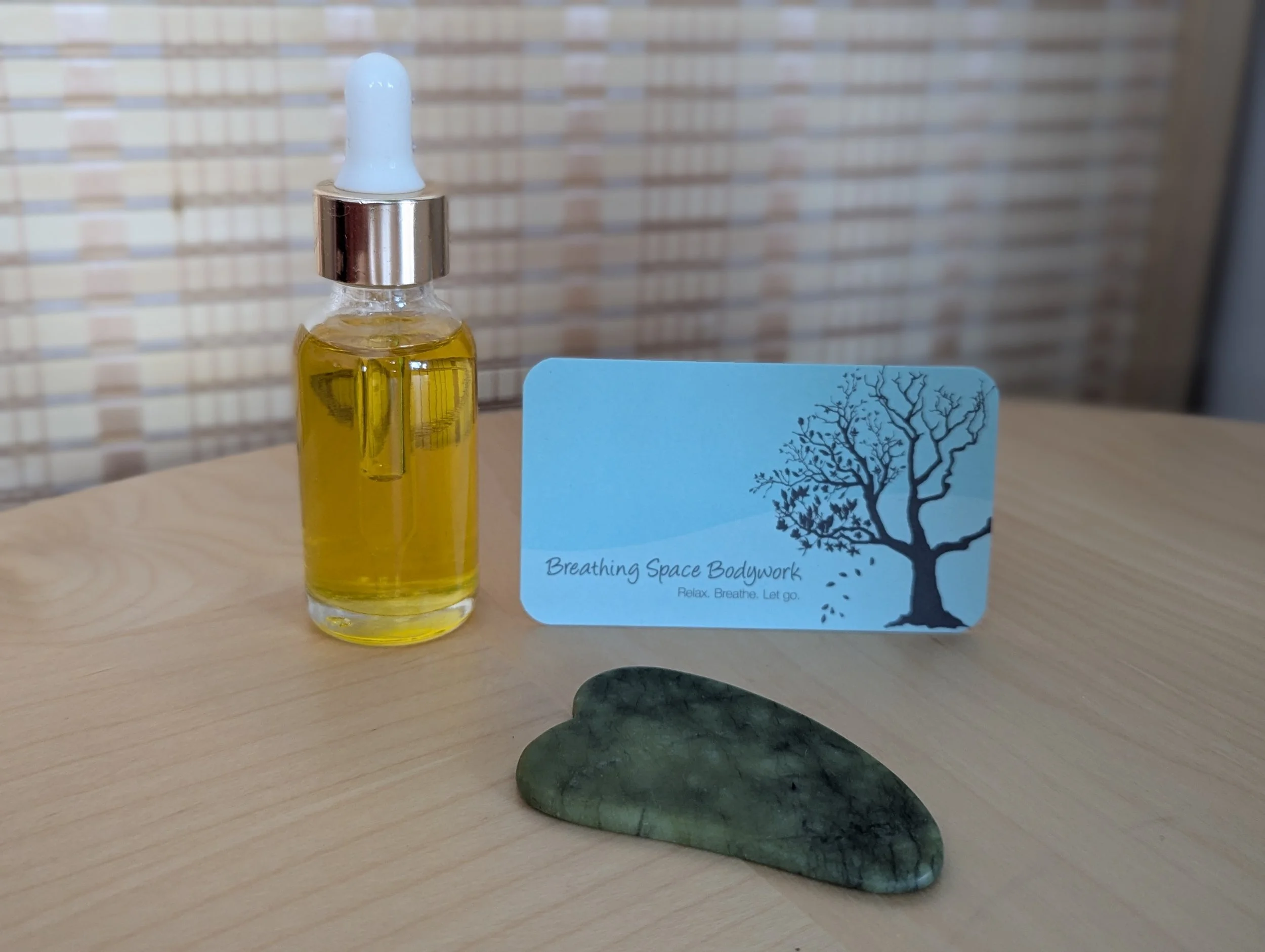
Tridoshic facial oil and jade gua sha tool.

If you’ve only heard of gua sha through social media, it can seem like a modern facial “beauty hack.”

But gua sha is not new — and it’s not just cosmetic.

Gua sha comes from a long lineage of Traditional Chinese Medicine (TCM), where it has been practiced for generations as a therapeutic technique to support circulation, reduce tension, and help the body move stagnation. While facial gua sha has become more visible in wellness culture recently, the true value of this practice is rooted in something much deeper: restoring flow, easing held tension, and supporting whole-body regulation.

In this post, I want to share gua sha from a wellness lens — not as a trend — and offer clarity on the difference between traditional body gua sha and facial gua sha, so the roots of this practice are honoured.

The Origins of Gua Sha (And Why “Scraping” Is Part of the Tradition)

Gua sha originates in Traditional Chinese Medicine. The term itself translates roughly to “scraping sand.”

  • gua = to scrape

  • sha = the reddish or purple “sand-like” marks that can appear on the skin

Those marks are not an injury — traditionally, they’re seen as a sign that stagnation has been moved and circulation has increased in an area.

In traditional body gua sha, a smooth-edged tool is used with oil to apply firm, repeated scraping strokes along areas like the neck, shoulders, back, arms, or legs. The intention is therapeutic and functional — often used to reduce pain, soften tight muscles, support immune response, and move stagnation.

This matters to name clearly: gua sha was never designed as a beauty ritual. It is an established, time-tested approach to healing and circulation support.

Facial vs. Body Gua Sha: Same Roots, Different Technique

Facial gua sha is not a replacement for body gua sha, and it is not meant to create the same effect.

It comes from the same lineage, but it’s applied differently because the tissues of the face are more delicate and vascular. The technique shifts from deep scraping to gentle, precise strokes.

Traditional body gua sha

Body gua sha typically involves:

  • firmer pressure

  • repeated scraping strokes

  • the intentional appearance of sha marks

  • a focus on pain relief, stagnation, and circulation support

Facial gua sha

Facial gua sha involves:

  • light pressure

  • slow, gliding strokes

  • no sha marks (the goal is not to raise sha on the face)

  • a focus on drainage, circulation, and relaxation of the face and jaw

Both practices are valid — and both have value — but they are not the same technique. In today’s wellness world, facial gua sha is what many people are introduced to first. I believe it’s important that we also understand and respect its deeper origin.

Why Facial Gua Sha Feels So Good (And Why It’s Therapeutic)

Facial gua sha is often described as “lifting” or “sculpting,” but in a wellness setting, the benefits are much more meaningful:

  • reduced facial and jaw tension

  • improved circulation and oxygenation

  • support for lymphatic flow

  • nervous system down-regulation

  • a sense of ease in the head, face, and neck

For many people, this can be one of the most relieving treatments they’ve experienced — not because it changes the face, but because it changes how the body feels.

1) It Supports Lymphatic Flow

The lymphatic system is responsible for moving fluid, waste, and immune activity through the body. Unlike blood circulation, it doesn’t have a pump — it relies heavily on movement.

Facial gua sha uses gentle strokes to encourage fluid movement toward lymph nodes in the jawline, around the ears, and down the neck. This can be supportive if you experience:

  • facial puffiness

  • sinus heaviness or congestion

  • swelling around the jaw or cheeks

  • a “stuck” or heavy feeling in the face/head

In many cases, puffiness isn’t a sign of aging — it’s simply a sign of stagnation.

2) It Relieves Jaw and Facial Holding Patterns

Most of us don’t realize how much stress we store in the face.

The jaw (masseter), temples (temporalis), forehead, scalp, and even the muscles around the eyes often hold chronic tension — especially for people who clench, grind, overwork, or spend long hours on screens.

Facial gua sha can gently soften these areas and support:

  • TMJ tension relief

  • reduction in clenching patterns

  • easing of temple pressure

  • fewer tension headaches

  • a softer, calmer facial expression

There’s a reason jaw work can feel emotional or deeply releasing — the jaw is one of the body’s most common “stress storage” zones.

3) It Improves Circulation and Tissue Vitality

One of the most widely recognized physiological effects of gua sha is improved microcirculation.

Even gentle facial strokes can help increase blood flow to the tissues, which supports:

  • nourishment to the skin and fascia

  • recovery from tension patterns

  • tissue tone and resilience

  • that bright, “awake” feeling after treatment

This isn’t about chasing a certain look — it’s about giving the tissues what they need to function well.

4) It Supports the Nervous System (The Most Overlooked Benefit)

This is the part I care about most.

Facial gua sha becomes deeply therapeutic when it’s performed slowly, rhythmically, and with a grounded presence. The face is rich in sensory nerves, and gentle touch can signal safety to the brain. When the nervous system receives that message, we often notice:

  • deeper breathing

  • lowered stress response

  • softened facial tension

  • improved sleep

  • less clenching

  • a calmer mental state

In other words: facial gua sha can help the body shift out of “on guard” mode.

Many people leave feeling lighter, clearer, and more regulated — and that’s the kind of wellness that matters.

Hot + Cold Tools: A Simple but Powerful Reset

One of the beautiful ways facial gua sha can be supported is through temperature.

Heat and cold are both traditional therapeutic tools:

  • Warmth helps soften tissues, relax muscles, and encourage circulation

  • Cooling tools can reduce inflammation, ease swelling, and calm irritation

Together, they create a gentle reset — especially for those who carry stress in the face and jaw or experience inflammation and congestion.

A Gentle Reminder: Facial Gua Sha Should Never Hurt

Facial gua sha is not meant to be aggressive.

More pressure isn’t better — especially on the face.

When done properly, facial gua sha should feel soothing, relieving, and supportive. It should not create bruising or leave sha marks. (That scraping effect belongs to traditional body gua sha — not facial work.)

Benefits of gua sha:

  • softness

  • circulation

  • ease in the jaw and forehead

  • a calmer nervous system

  • a feeling of flow instead of holding

That is wellness.

And while gua sha can absolutely improve the appearance of the skin, its deeper value is how it supports the body underneath the surface.

When the jaw unclenches, the forehead softens, the breath drops lower, and the neck releases — we’re not chasing beauty.

We’re supporting regulation.

It’s especially supportive for people who feel:

  • tension in the jaw, temples, or forehead

  • stress held in the face and neck

  • chronic clenching or TMJ discomfort

  • puffiness, congestion, or heaviness in the head

  • a desire to feel calmer and more grounded

Because when the face relaxes, the whole body often follows.

Let’s find the space your body needs to relax, breathe, and let go.

Hot Towels, Cold Stones: The Subtle Art of Hydrotherapy

four white towels rolled up inside a hot towel cabby with the uv light on

Towels heating the UV sterilizing warmer

At Breathing Space Bodywork, every element of your session is intentional — chosen to support comfort, ease, and integration. One of the quiet foundations of my work is hydrotherapy: the therapeutic use of water in its various forms and temperatures to support the body’s natural ability to relax and restore balance.

What Is Hydrotherapy?

Hydrotherapy is one of the oldest healing practices. It uses water — in the form of steam, compresses, wraps, or stones — to influence circulation, skin, muscle tone, and the nervous system. In bodywork, hydrotherapy is less about immersion and more about targeted temperature application — using heat or cold to help the body respond, soften, and heal.

How I Use Hydrotherapy

In my practice, hydrotherapy appears as hot towel compresses, warm foot wraps, and cold marble stones. These simple tools add depth and intention to each treatment, enhancing both comfort and effectiveness.

  • Hot towels for the feet:
    Before reflexology, warm towels are wrapped around the feet to soften the skin and heat the reflex points. This gentle warmth stimulates circulation, preparing the tissue for deeper work and creating a sense of grounding from the very start.

  • Aromatherapy compresses for tension:
    When I encounter areas of stubborn muscle tension, I create a hot towel compress infused with essential oils. The towel is applied, covered, and topped with a Thermophore to sustain the heat. The moist warmth penetrates deeply, helping to soften tight tissue and ease the nervous system — an invitation for the body to release without force.

  • Cold marble stones for balance:
    After focused or deep work, cold stones bring grounding and renewal. Stored in the freezer, the marble holds a true cold that calms inflammation, tones the tissue, and helps the body integrate the work. The temperature contrast restores equilibrium, leaving you both relaxed and refreshed.

Why Temperature Matters

Temperature is a language the body understands.
Heat encourages expansion — softening muscles, opening pores, increasing circulation, and soothing the nervous system.
Cold brings clarity — reducing inflammation, calming the skin, and grounding the senses.
Used together, they create rhythm and balance within the body — activating natural healing responses while deepening relaxation.

How Hydrotherapy Enhances Bodywork

Hydrotherapy deepens the bodywork experience by blending comfort with effectiveness. The use of heat and cold supports the body in ways that hands alone cannot.
For the client, the warmth of a towel or the cool touch of marble adds a soothing, sensory dimension — easing tension and helping the body feel nurtured and cared for.
For the practitioner, these tools make it possible to work with tissue that’s already softened, allowing for deeper, more responsive work without strain or discomfort.
It’s a subtle yet powerful enhancement — one that helps every session feel intentional, restorative, and complete.

The Element of Water

Water carries memory, movement, and flow. Whether through the warmth of steam or the cold touch of stone, hydrotherapy connects you back to that fluid state — one where letting go feels natural.

relax, breathe, let go.