
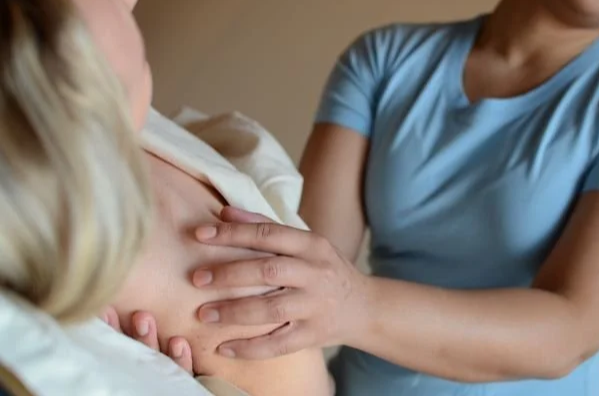
Yesterday, I received bodywork from a colleague of mine. As soon as her hands made contact, everything shifted. I felt it immediately—a sense of being cared for, of being met, of being heard.
She approached me with confidence and kindness. Her hands were attentive and specific. She immediately sensed where my body was holding and went there with clarity. Not forcefully, but with a kind of quiet precision that let me know she “had me” then, I started to cry.
Not because something was wrong, but because something was right.
In that moment, I realized, this is what people feel when they are on my table… safe and cared for!
(It so rare for me to feel completely safe in the hands of another practitioner. And that is a topic for another blog post)
Safety is felt, not forced.
Safety is not something we think our way into. It is something we feel. It shows up in the way someone makes contact, in the pacing of their touch, and in their ability to stay present without trying to change what is happening. When that kind of care is present, the body recognizes it. When the body feels safe, it begins to let go.
There is often an assumption that bodywork is about applying the right technique or using the right amount of pressure. While those things matter, they are not what creates the deeper shifts people are often looking for. The body does not let go because it is told to. It lets go when it no longer needs to hold.
That is where listening becomes essential.
Listening with the hands
Listening, in this context, is not passive. It is an active, ongoing process of feeling how the body is responding and then adjusting accordingly. It means paying attention to subtle changes in tissue, breath, and tone. It means knowing when to stay, when to shift, and when to give the body space to respond.
When someone is truly listening with their hands, you can feel the difference. There is less effort in your own body. You are not bracing or anticipating what is coming next. You are able to relax, breathe, and let go.
You may start to notice areas of tension that were previously outside of your awareness. You may feel changes in your breathing, or a sense of movement through the body. Sometimes there is a visible softening. Sometimes there is an emotional response.
Skilled touch: precision without force
Skilled touch is not defined by how much pressure is used, but by how specific it is.
When touch is precise, it can meet the body exactly where it is without overwhelming it. There is no need to push through resistance or force change. Instead, the work is directed, intentional, and effective.
This kind of precision comes from experience, but also from restraint. From knowing that more is not always better, and that doing less—when it is accurate—often creates a deeper response.
When the body is met with that level of clarity, it doesn’t need to defend itself. It doesn’t need to brace or protect. It can respond.
There is a sense of being met in real time. The work is not being applied to you—it is being shaped by what your body is communicating. That creates a different kind of trust. Not something you have to think about, but something your body recognizes immediately.
Allowing, not forcing
There is a tendency to think of tension as something that needs to be released, worked out, or pushed through.
But the body does not respond well to force. It responds to the right conditions.
When those conditions are in place, change happens naturally. The breath deepens. The tissue begins to soften. The nervous system shifts out of a constant state of holding.
And sometimes, emotions surface.
Not because something is being forced out, but because something is finally allowed.
The work beneath the work
What I experienced yesterday was a reminder of why this work matters to me.
It is not about working on the body in isolation. It is about creating the conditions where the body feels supported enough to shift.
People often come in with specific areas of tension or discomfort, but what they are really seeking is a different experience of themselves. Less holding. More ease. A sense that their body is not something they have to manage.
That kind of change does not come from technique alone. It comes from care, from attention, and from the ability to meet the body where it is.
When those elements are in place, the work becomes less about doing something to the body and more about working with it.
And when that happens, the body often does what it has been trying to do all along.
It lets go.