
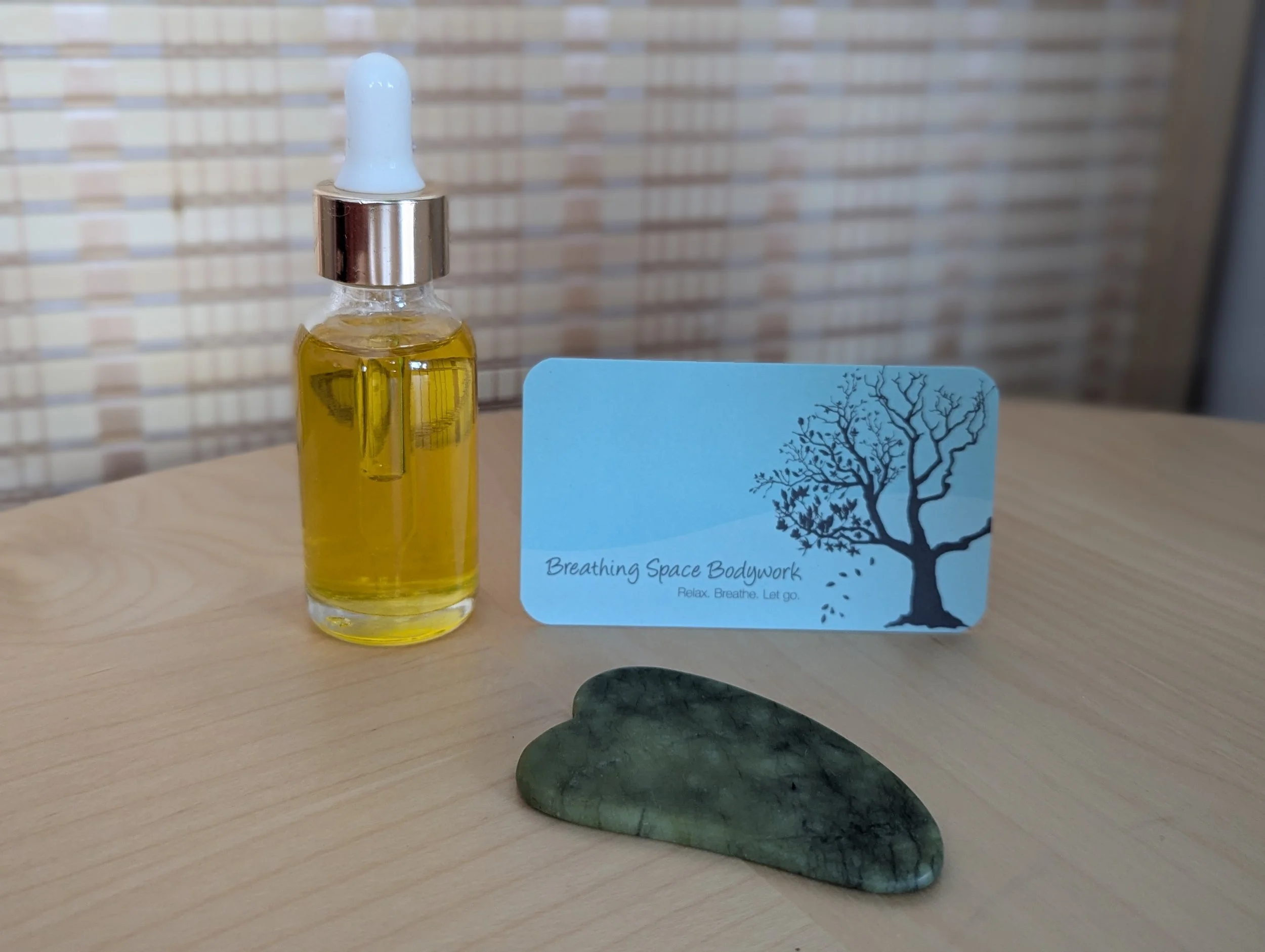
Tridoshic facial oil and jade gua sha tool.
If you’ve only heard of gua sha through social media, it can seem like a modern facial “beauty hack.”
But gua sha is not new — and it’s not just cosmetic.
Gua sha comes from a long lineage of Traditional Chinese Medicine (TCM), where it has been practiced for generations as a therapeutic technique to support circulation, reduce tension, and help the body move stagnation. While facial gua sha has become more visible in wellness culture recently, the true value of this practice is rooted in something much deeper: restoring flow, easing held tension, and supporting whole-body regulation.
In this post, I want to share gua sha from a wellness lens — not as a trend — and offer clarity on the difference between traditional body gua sha and facial gua sha, so the roots of this practice are honoured.
The Origins of Gua Sha (And Why “Scraping” Is Part of the Tradition)
Gua sha originates in Traditional Chinese Medicine. The term itself translates roughly to “scraping sand.”
gua = to scrape
sha = the reddish or purple “sand-like” marks that can appear on the skin
Those marks are not an injury — traditionally, they’re seen as a sign that stagnation has been moved and circulation has increased in an area.
In traditional body gua sha, a smooth-edged tool is used with oil to apply firm, repeated scraping strokes along areas like the neck, shoulders, back, arms, or legs. The intention is therapeutic and functional — often used to reduce pain, soften tight muscles, support immune response, and move stagnation.
This matters to name clearly: gua sha was never designed as a beauty ritual. It is an established, time-tested approach to healing and circulation support.
Facial vs. Body Gua Sha: Same Roots, Different Technique
Facial gua sha is not a replacement for body gua sha, and it is not meant to create the same effect.
It comes from the same lineage, but it’s applied differently because the tissues of the face are more delicate and vascular. The technique shifts from deep scraping to gentle, precise strokes.
Traditional body gua sha
Body gua sha typically involves:
firmer pressure
repeated scraping strokes
the intentional appearance of sha marks
a focus on pain relief, stagnation, and circulation support
Facial gua sha
Facial gua sha involves:
light pressure
slow, gliding strokes
no sha marks (the goal is not to raise sha on the face)
a focus on drainage, circulation, and relaxation of the face and jaw
Both practices are valid — and both have value — but they are not the same technique. In today’s wellness world, facial gua sha is what many people are introduced to first. I believe it’s important that we also understand and respect its deeper origin.
Why Facial Gua Sha Feels So Good (And Why It’s Therapeutic)
Facial gua sha is often described as “lifting” or “sculpting,” but in a wellness setting, the benefits are much more meaningful:
reduced facial and jaw tension
improved circulation and oxygenation
support for lymphatic flow
nervous system down-regulation
a sense of ease in the head, face, and neck
For many people, this can be one of the most relieving treatments they’ve experienced — not because it changes the face, but because it changes how the body feels.
1) It Supports Lymphatic Flow
The lymphatic system is responsible for moving fluid, waste, and immune activity through the body. Unlike blood circulation, it doesn’t have a pump — it relies heavily on movement.
Facial gua sha uses gentle strokes to encourage fluid movement toward lymph nodes in the jawline, around the ears, and down the neck. This can be supportive if you experience:
facial puffiness
sinus heaviness or congestion
swelling around the jaw or cheeks
a “stuck” or heavy feeling in the face/head
In many cases, puffiness isn’t a sign of aging — it’s simply a sign of stagnation.
2) It Relieves Jaw and Facial Holding Patterns
Most of us don’t realize how much stress we store in the face.
The jaw (masseter), temples (temporalis), forehead, scalp, and even the muscles around the eyes often hold chronic tension — especially for people who clench, grind, overwork, or spend long hours on screens.
Facial gua sha can gently soften these areas and support:
TMJ tension relief
reduction in clenching patterns
easing of temple pressure
fewer tension headaches
a softer, calmer facial expression
There’s a reason jaw work can feel emotional or deeply releasing — the jaw is one of the body’s most common “stress storage” zones.
3) It Improves Circulation and Tissue Vitality
One of the most widely recognized physiological effects of gua sha is improved microcirculation.
Even gentle facial strokes can help increase blood flow to the tissues, which supports:
nourishment to the skin and fascia
recovery from tension patterns
tissue tone and resilience
that bright, “awake” feeling after treatment
This isn’t about chasing a certain look — it’s about giving the tissues what they need to function well.
4) It Supports the Nervous System (The Most Overlooked Benefit)
This is the part I care about most.
Facial gua sha becomes deeply therapeutic when it’s performed slowly, rhythmically, and with a grounded presence. The face is rich in sensory nerves, and gentle touch can signal safety to the brain. When the nervous system receives that message, we often notice:
deeper breathing
lowered stress response
softened facial tension
improved sleep
less clenching
a calmer mental state
In other words: facial gua sha can help the body shift out of “on guard” mode.
Many people leave feeling lighter, clearer, and more regulated — and that’s the kind of wellness that matters.
Hot + Cold Tools: A Simple but Powerful Reset
One of the beautiful ways facial gua sha can be supported is through temperature.
Heat and cold are both traditional therapeutic tools:
Warmth helps soften tissues, relax muscles, and encourage circulation
Cooling tools can reduce inflammation, ease swelling, and calm irritation
Together, they create a gentle reset — especially for those who carry stress in the face and jaw or experience inflammation and congestion.
A Gentle Reminder: Facial Gua Sha Should Never Hurt
Facial gua sha is not meant to be aggressive.
More pressure isn’t better — especially on the face.
When done properly, facial gua sha should feel soothing, relieving, and supportive. It should not create bruising or leave sha marks. (That scraping effect belongs to traditional body gua sha — not facial work.)
Benefits of gua sha:
softness
circulation
ease in the jaw and forehead
a calmer nervous system
a feeling of flow instead of holding
That is wellness.
And while gua sha can absolutely improve the appearance of the skin, its deeper value is how it supports the body underneath the surface.
When the jaw unclenches, the forehead softens, the breath drops lower, and the neck releases — we’re not chasing beauty.
We’re supporting regulation.
It’s especially supportive for people who feel:
tension in the jaw, temples, or forehead
stress held in the face and neck
chronic clenching or TMJ discomfort
puffiness, congestion, or heaviness in the head
a desire to feel calmer and more grounded
Because when the face relaxes, the whole body often follows.
Let’s find the space your body needs to relax, breathe, and let go.